The smell of desperation is repulsive.
I know. It isn’t a kind thing to say. But it’s the truth.
And when you are feeling scared in a job search, desperation is what creeps in. It’s what your inner saboteurs whisper to you:
The clock is ticking
Others are landing roles
You’re just not that desirable
No one wants you anymore
You’ve peaked and the rest is downhill
You may feel like it’s all in your head, but it isn’t.
It seeps out into your interactions. It makes you furrow your brows, tighten your shoulders, forget to take a breath.
You start to be less present, let your anxiety drive your thoughts, and you don’t project confidence.
It’s scary. I know because I’ve felt it.
And I coach clients that feel it, too. Successful, type-A winners who are in the thick of it.
So what can they do?
Shift your narrative away from what you need to what they need.
The change feels small, but it’s actually enormous.
When you shift to what others need, you’re not just refocusing your attention. You’re implying something significant:
That you are complete and whole.
Sounds a bit woo, right?
It’s actually based on science: evolutionary, psychological, and behavioral.
Evolutionary: We seek out people who will help us survive.
Psychological: We want to be around people who will energize us, not drain us.
Behavioral: We avoid people who may limit our autonomy because their fear and needs may dominate the relationship.
These are relationship-driven judgments, but they apply to the workplace just as much as they apply to other social environments.
We want to be around people who can help us be successful, not take advantage of us or limit us.
Start with figuring out who needs you and why.
Think about who you like to help and how you can support them. For example, if you’re a C-Suite leader, there are a variety of ways to frame who needs you and their needs:
Customer needs:
Industry dynamics and competitive landscape
Consumer vs. B2B vs. other sectors (e.g. philanthropic, education, government)
New advancements and areas that are underserved
Company needs:
Are they early-stage and needing someone to set up all the foundational elements?
Or have they proven the initial model and need you to scale it?
Or is it a turnaround situation where they need you to identify the issues and problem-solve?
When you have a clear understanding of who needs you and why, it’s much easier to frame why you.
Hone your narrative on what you have to offer.
When we think about what we have to offer in terms of who we are helping and why, it feels less like a sales pitch and more like a conversation of finding a match.
There are customers and organizations who need your skillset to help them address meaningful issues and create real value.
Your narrative should help them understand how you can do that.
Here’s a simple template:
I help _______ with _______ so that they can achieve _______.
I bring ________ experience and ________ skills through my past work delivering/achieving ________ results/outcome.
You will ultimately say more when you’re talking with people or even sending a message, but this is a simple way to shift your narrative from focused on you (“I want…” or “I’m looking for…”) to focused on who you can help.
Then meet as many people as you can.
Once you have your narrative down, it’s time to test it out.
You won’t know how it lands until you try it on for size.
You’re not just seeing how others respond. You’re seeing how you feel saying it… out loud.
It’s amazing how much emerges when you say something out loud.
What you thought was the perfect framing can all of a sudden feel pushy, inauthentic, too buzzwordy, or just not quite right.
Don’t be afraid to tweak as you go.
The key is to keep going.
Every person you meet is someone who might be the connection.
Yes, you can be targeted about your approach, but to start, go broad and go wide. Chances are, you don’t know the person who needs you or who will know someone who does.
The power of human connections is real, but it’s also mysterious. Before you meet with someone, they won’t know what’s in your head, and you won’t know who’s in their life.
It isn’t only former colleagues or current business partners who might be relevant. It could be a friend with a shared hobby, a gym buddy, a family member, or even a neighbor.
This is why volume matters.
Forming a meaningful connection starts with curiosity, not a pitch.
So you schedule the conversation — woo hoo!
How you enter the conversation is as important as how you reframed your mindset from needing a job to wanting to help.
Relationships that last are built through mutual interest.
That starts with curiosity.
Sure you can share your narrative, but I recommend you spend as little time on you as possible. If they ask you, don’t be evasive — share away. But after you do a brief, emphasis on brief (like 2-3 min) intro, focus on them.
Get to know them and what matters to them. Learn about their career trajectory and what they aim for.
Even if you don’t find common ground, at worst, they may offer valuable insights and inspiration. At best, you’ll discover threads that allow you to go deeper and perhaps find a path to a person or organization that could be on the path to the people who need you.
Be relentless. Be thoughtful. Be patient.
This shift could take you a few minutes to make.
More likely, it’ll require practice and revisiting over time. That’s normal when you’re building a new habit.
The question isn’t how fast this will work. The question is how much more sustainable and energized you’ll feel during your search process.
The reality: it is taking senior leaders 12-18 months to land a new role.
By making this shift, you may shorten the time frame. But even if you don’t, you’ll be on a path to creating stronger relationships and a healthier mindset, both of which will help you in your next role and far beyond.
Thank you for joining me this week. If this resonated for you, please take a moment to add a ❤️ so that more people can find it on Substack.
Please also feel free to share it with someone who needs it.
And if you want more from me, follow me on LinkedIn. I share advice every week like this one below:
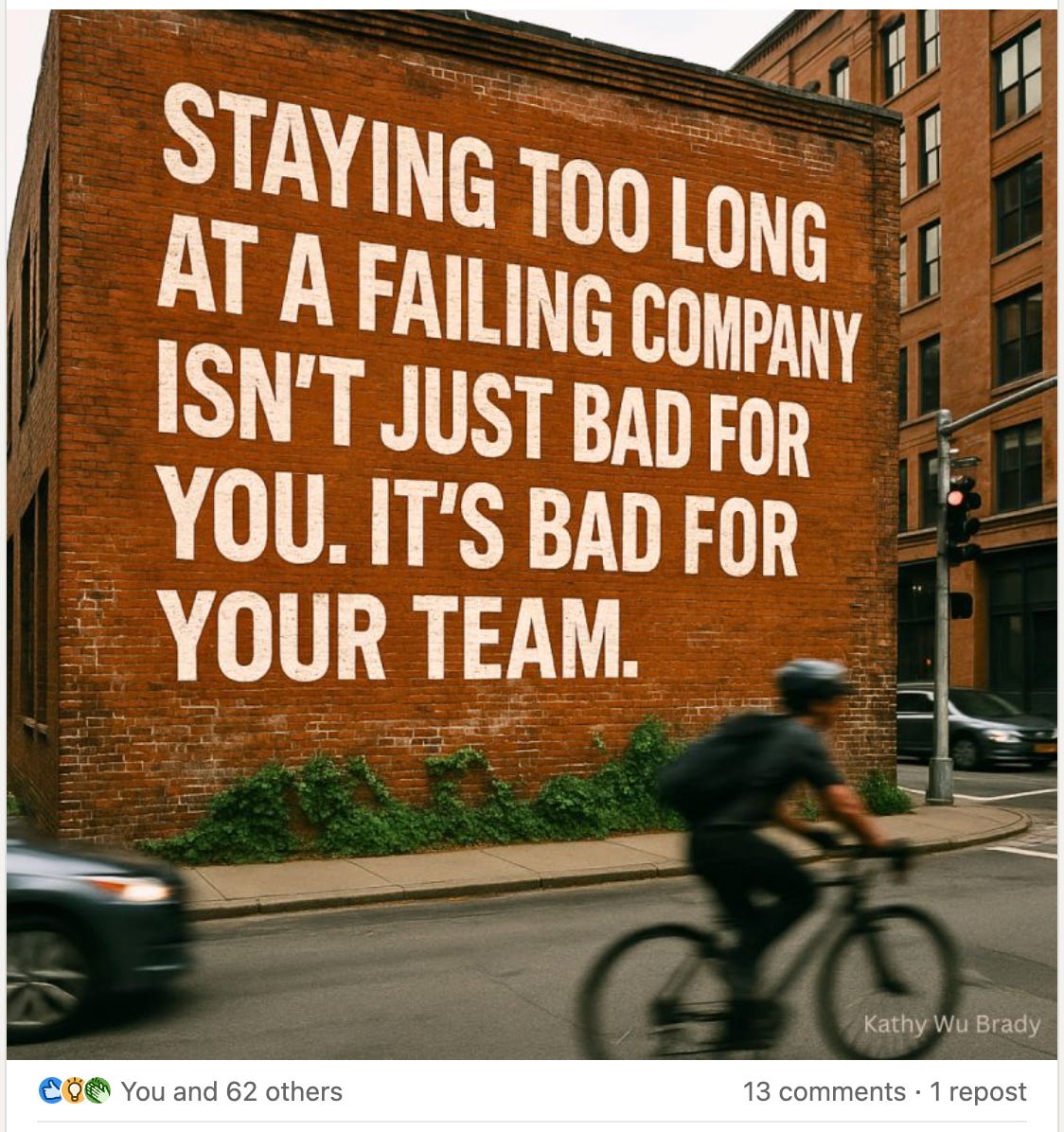
Most execs wait too long to leave a failing company.
Wishing you a great start to your February!
May you lead without limits,