



“Why am I the only one naming the problems? Doesn’t everyone else see it? We’re wasting time!”
One of my clients, Malcolm, a talented EVP and division leader, is frustrated beyond measure.
He thought he was joining an ambitious, smart group of leaders, ready to accelerate the business.
His due diligence didn’t surface that underneath their buttoned-up exterior was a fear of upsetting others that resulted in endless meetings to hash and rehash issues. Critical blockers left unaddressed. Solutions unexplored because no one had the guts to raise the alarm.
I helped build a room like that.
Sadly, it’s a familiar situation that exists in many organizations. The lost time and energy are the most immediate impacts, but that’s only the start.
I’ve experienced this firsthand. In fact, I feel ashamed that I unwittingly helped perpetuate it in some of the companies I led.
I didn’t understand the damage I was causing until I learned of Kim Scott’s Radical Candor framework nearly 10 years ago.
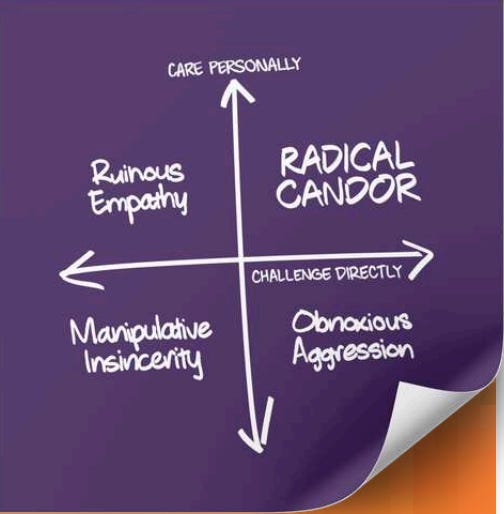
It was the first time someone put such insightful words to my experience of balancing empathy and directness.
As someone who spent much of my early life living with someone who leaned towards obnoxious aggression, I defaulted to deep empathy. The fear and pain caused by this person in my life left deep scars. Speaking up more often led to demeaning shouting matches and tears rather than any productive outcome. I vowed never to make anyone feel that way.
But I wasn’t conscious of how a proclivity towards caring for someone else’s feelings could lead to ruinous empathy. It doesn’t just hurt an organization’s overall effectiveness, but also the relationships within it.
I learned this the hard way in one of my roles as a division lead. Working in a matrixed structure, I had a product partner who wasn’t developing the solutions we needed to drive commercial success. Our conversations were always friendly and congenial, but I only hinted at what I really wanted: faster feature delivery for partners and improved KPIs.
After 3 months, nothing changed.
My team, frustrated with my approach, asked me why I wasn’t pushing harder. My response was always, “He just needs time. He’ll get there when he gets there. We’ll be OK.”
I ended up being right and wrong.
The part of the business that depended on my collaboration with this particular product partner floundered, but another part of my business grew by leaps and bounds, masking the issue. My product partner never delivered the KPI results we needed, and no one but my team felt the miss.
Just because I got lucky didn't mean I had the right approach.
It took me a long time to realize it, but my miss wasn’t really about financial targets. It cost me the kind of relationship I value, one based on trust and mutual respect.
When I decided, consciously or not, to avoid telling him exactly what I was seeing and concerned about, I chose not to trust that he could handle that truth. I chose not to trust that he could address the issue. I chose to stay on the safe side of the relationship at the cost of both of our learning and growth as leaders.
Hi there! The rest of this piece is for my paid subscribers.
Join now to access all of my actionable, weekly essays. Plus, this fall, I am launching a monthly live group coaching session for all paid subscribers.
If you’ve been wanting to work with me but 1:1 coaching has felt out of reach, this is your opportunity. Rates will increase after the launch.
